
Growing guide
How to grow squash in Ireland
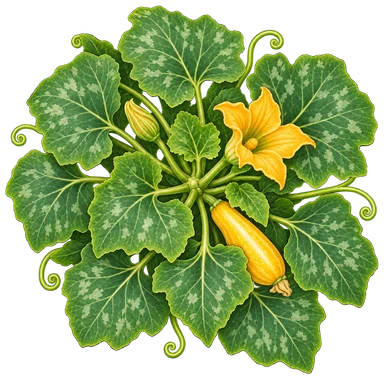
Squash is a broad family, not one uniform crop. Summer types are eaten young; winter squash, including pumpkins, mature on the vine and develop skins suitable for storage. Choose an edible variety and check whether it forms a compact bush or a spreading vine. In Ireland, the challenge is giving tender plants enough warmth and time to ripen before frost.
On this page
At a glance
- Start with
- Seed or young plants of an edible variety
- Best position
- Rich, well-drained soil; a warm position with space for trailing stems
When and where to start
Indoor sowing. Sow singly in large modules or 7–8 cm pots in late April or early May, around 20 °C. Provide frost protection throughout propagation.
Direct sowing. Teagasc allows direct sowing when soil reaches about 11–12 °C. A May reference is not a fixed safe date; delay in a cold or frost-prone garden.
Planting out. Plants may be ready after three to four weeks. Harden off, then plant after local frost risk has passed; mid-May to early June is the guide’s broad window.
Planting and spacing
Use one seed per pot and follow its packet’s sowing-depth instructions. Depth instructions can vary with the seed supplied.
Teagasc describes two rows on a 1.4 m bed with plants 85–90 cm apart, or flat-ground layouts of 1 × 1 m to 1.5 × 0.75 m. These are stated methods, not interchangeable single distances.
Match the space to the variety’s mature habit. A sprawling vine must not block all access for weeding and inspecting fruit. Prefer a site without squash in the previous three or four years where practical.
Routine care
Weed before vines make the ground difficult to reach. Keep roots supplied with moisture without waterlogging them, and avoid excessive nitrogen feeding.
Handle stems carefully when working around plants. Keep tender transplants protected if cold returns rather than expecting established leaves to withstand frost.
What to watch for
Look for slug damage at planting. Powdery mildew can produce a pale coating on leaves; a severe early attack may shorten the productive season.
Fruit rots can develop before or after harvest. Damaged pumpkin skin heals poorly, so protect fruit from cuts and bruising. Do not put damaged specimens in with sound storage fruit.
Harvest and storage
Pick summer squash immature for fresh eating. Winter squash needs to reach its variety’s mature colour and condition on the vine where possible, but harvest before frost.
Leave a sound stem attached; Teagasc gives 10–15 cm for pumpkins. Curing means allowing skin to harden and the stem wound to seal. The guide describes about two weeks near 25 °C in a ventilated protected space when needed.
Store sound winter fruit at about 7–13 °C. Teagasc gives two to six months depending on cultivar, not a guarantee for every fruit. Check the crop regularly and separate anything developing decay.
Common questions
Does winter squash grow through winter?
No. The name refers to mature fruit stored for winter use, not frost-hardy plants.
Are decorative gourds automatically edible?
No. Choose a variety explicitly intended for eating; the squash family includes ornamental forms.
Can damaged squash be stored with the rest?
Keep it separate. Injured skin increases the risk of decay and makes long storage less reliable.